
Everyone’s a Peptide Rep Now
Easy access, optional guidance, and a whole category running on borrowed trust.
Here’s the latest on peptides: everyone’s selling them.
Your trainer has a guy. Your health-conscious buddy from work has a source. And your neighbor is now pushing the Wolverine Stack out of a group chat with the same energy moms used to sell essential oils out of the back of a minivan. Huberman spends two and a half hours on peptides and the group chats light up for a week. And the pitch is always some version of the same sentence. I swear these are legit, I know someone who knows someone.
And the thought occurred to me: this all feels less like healthcare and more like multi-level marketing.
I want to be clear up front. I’m not only not anti-peptide, I think peptides are going to play a significant role in affecting health outcomes moving forward. I’m on BPC-157 right now, recovering from spinal surgery, and I’m taking it because I made an educated guess about where it came from and decided the upside was worth what some would call…a roll of the dice. The biology is real. Signaling molecules that nudge repair systems your body already runs. And I unequivocally notice a difference.
But spun another way, I’m an investor who studies this category for a living - and I’m dosing a compound based on relatively blind faith about where these vials in my fridge came from. Given that’s my situation, I find myself constantly thinking about everyone else’s.
A few months back, I started microdosing a GLP-1 and kept a couple weeks of field notes I never published. (They exist. Maybe I’ll post them someday.) The reason I did it at all is that Pave lives in this world. We underwrite consumer health for a living, and at some point it felt indefensible to have opinions about the biggest consumer health story in a decade without putting it in my own body. The most educational part wasn’t the appetite suppression. It was the buying experience. I got it from a colleague. Not a doctor, not a pharmacy. Someone with zero responsibility to coach me through anything. Swabs, syringes, a vague dose, good luck. Same as the BPC. Access is easy. Guidance is optional, and from what I've seen, rarely happening. Rarely.
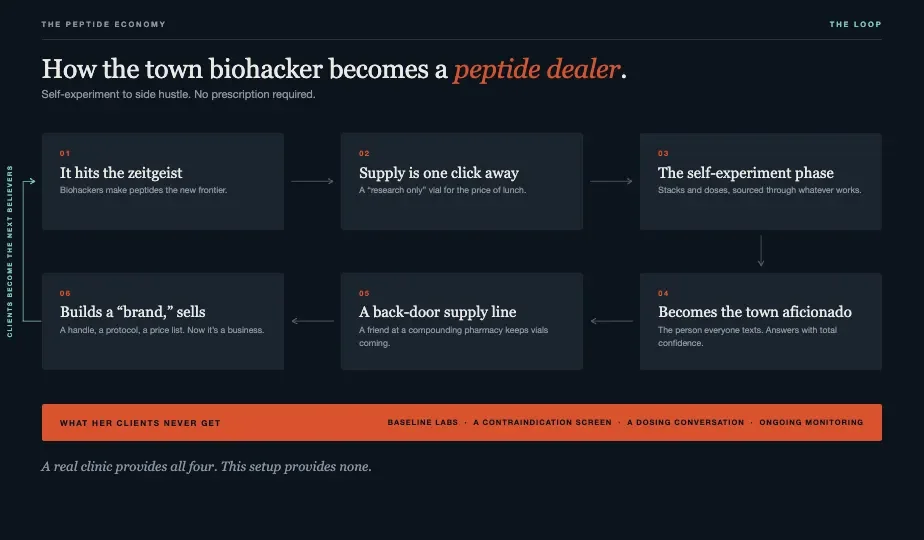
Most wellness peptides are old, unpatented molecules anyone can make cheaply. BPC-157 is a published sequence nobody owns. When nobody owns the molecule, the money lives in moving it. So the market built itself around movement. People inside the category will tell you it’s roughly 70% offshore dropshippers, with most of the rest locked in clinical injection protocols. Everything in between is the long tail: research-use-only websites, injection menus at wellness studios, regular and absolutely credential-less average joes reselling to their family, friends, and coworkers. Classic MLM economics. Commodity product, margin in distribution, trust borrowed from whoever you happen to know.
Even the funded end has gold rush energy. A lot of the brands rising right now are run by marketers who wandered in because the wave was there, same as people wandered into CBD a few years back. The skill set is real, the molecule is incidental. They’re distribution operators who picked a category, and peptides happened to be the one with heat.
The doctor layer is part of the show too. Across wellness, the credential is becoming a marketing asset as much as a clinical one. A face in a white coat converts, so the incentive is to put one out front whether or not it changes anything about the product. It’s a short walk from there to the MLM convention stage, where a doctor in a lanyard tells the room the product changed his practice.
And the data underneath is thin. New formats are starting to pop up, patches and oral versions and sprays, sold mostly on the reputation of the molecule rather than proof the format actually delivers it into your body. Bioavailability is the whole game with a peptide, and it’s the thing least often demonstrated. Independent testing of gray-market product has reportedly found a large share of samples failing basic purity standards. Wrong contents, contamination, doses off the label. And nobody’s asking the intake questions a real signaling molecule deserves. Gut, liver, cancer history, current meds. The MLM hook is the easy part to laugh at. The screening gap is the part that actually gets a little scary.
The uncomfortable part
Here’s what I can’t pretend my way around. I’m in this system, not above it.
I source from someone adjacent to the connections that supposedly hold the highest standards. And if I’m honest, I have no real faith those standards mean much. I vet companies for a living, and I can’t tell you the premium source is meaningfully safer than the concierge longevity clinic down the street or the e-comm brand that launched last quarter. Nobody screened my history. Nobody armed me with anything I couldn’t have assembled myself in an afternoon talking it through with an AI. At the supposedly legitimate tier, the legitimacy is mostly positioning. The clinical work is mostly missing.
That’s not a knock on the people I buy from. It’s the whole problem. If the trust gap reached me, someone who does this professionally and went in skeptical, it’s everywhere.
Where this goes: the supplement playbook
An FDA advisory committee is set to review a batch of these restricted peptides this summer. If it goes the way the noise suggests, several could become legally available through licensed compounding pharmacies with a physician’s prescription for the first time in years. That single decision reorganizes everything, and the current frenzy is partly a bet on it. Gray markets always sell hardest right before the rules arrive.
So where does this go? Look at supplements.
The supplement business is a multibillion-dollar market built almost entirely on commodity ingredients nobody owns. Creatine, magnesium, whey, fish oil. None of it is proprietary. The FDA doesn’t clear supplements before they’re sold, it mostly steps in after something goes wrong. So the shelf ends up split: a long tail of cheap, untested, who-knows-what’s-actually-in-it junk, and a smaller set of brands that won by doing the boring things. Third-party testing. Transparent sourcing. A label you can believe. Same ingredient, wildly different trust, and the trusted names command the premium. That is the market peptides are walking toward.
But first, the thing people get wrong. Legalization does not put peptides next to the magnesium on the grocery shelf. The FDA’s position is that synthetic peptides like BPC-157 aren’t dietary supplements, so the realistic outcome is a gated prescription-compounding lane with a doctor and a pharmacy in the loop, not an open aisle. Legitimate, but controlled. That distinction shapes everything that follows.
Even with a legal lane, the gray market doesn’t die. It sorts itself out, the same way the supplement shelf did. The cautious middle, people like me who’d happily pay more to stop guessing, moves to the tested, supervised option. The price-shoppers and the committed biohackers stay gray. You’re left with a trusted tier on top and a stubborn shadow market underneath. Same structure supplements landed on years ago.
And as it sorts, the molecule keeps getting cheaper and the margin keeps leaving it. Reclassification just adds supply and competition to something nobody can patent, so betting on owning the molecule is a losing hand. The money moves to what a competitor can’t copy by buying the same powder: a trusted brand, real testing data, the ongoing relationship with the customer, and the delivery itself. Delivery matters more than it sounds. How you take this stuff, oral, long-acting, anything that kills the needle and the daily ritual, is the rare piece that can actually be defended. This is exactly how supplements played out. Thorne didn’t win by inventing magnesium. It won by making testing and trust the product on top of a commodity.
The molecules keep getting better, on purpose
Right now, the loudest molecule in the room is retatrutide. People talk about it like a cheat code, a triple agonist that supposedly outperforms everything before it. And here’s the thing: they’re not wrong to be excited, and this is not a one-time event. Pharma’s whole incentive is to keep launching the next stepped-up version. A new molecule resets the patent clock, so the rational move is a permanent treadmill. The discovery side is speeding up too, with AI now used to design these multi-target molecules in months instead of years. Semaglutide begat tirzepatide begat retatrutide begat whatever’s in trials right now. Oral versions, longer-acting versions, fewer-side-effect versions. The miracles will keep arriving on a schedule. And regarding consumer brands playing in this space, whoever the customer already trusts when the new miracle drops…wins.
How the MLM phase resolves
MLMs die a predictable death. The downline saturates, the testimonials stop converting, somebody’s friend ends up with a garage full of product, and the brand becomes a punchline. The product was usually fine. The model simply burned the trust - oh how fondly I think back to the good ol’ Herbalife days.
The peptide version resolves the same way, and policy is the accelerant. A legal tier makes the casual reseller redundant and, by comparison, reckless. Who buys from a group chat when a supervised, tested version exists for a believable price? The category consolidates around a few brands that got the boring things right: sourcing, testing, screening, a format people will actually stick with.
Which brings me back to my own medicine cabinet. I’m rolling dice on a BPC vial because the trustworthy version of this category doesn’t exist yet. That’s the company we want to back: the one that does the work the gray market skips, owns how the molecule gets delivered, and keeps the customer when the hot compound changes next year. The molecule was always a commodity. The trust never was, and almost nobody’s selling it. We’d like to meet whoever decides to.